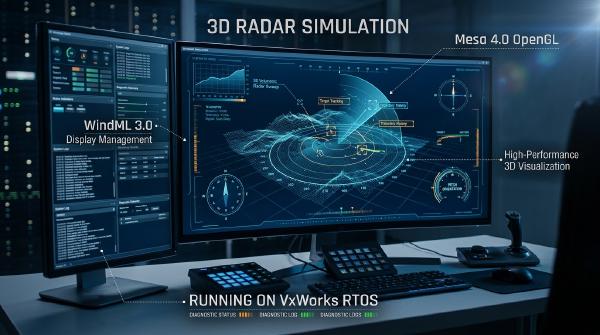
Design of 3D Graphics Components on VxWorks RTOS
Building 3D graphics components on a real-time operating system (RTOS) like VxWorks presents a unique set of challenges. Unlike standard desktop environments where the OS manages resources with high overhead, an RTOS requires deterministic behavior. You have to balance high-frequency rendering with strict task priorities.
🏗️ Component-Based Architecture Design #
A modular design is the only way to maintain sanity in a complex 3D system. By breaking the graphics engine into discrete components, you isolate the rendering logic from the application state and the hardware abstraction layer.
Scene Graph Management #
The scene graph acts as the backbone. It organizes the spatial relationships between objects. In a VxWorks environment, this component should handle the hierarchy of 3D models, lights, and cameras. Keeping the scene graph separate from the actual rendering calls allows for easier updates to the world state without re-triggering the entire pipeline.
Resource Manager #
Memory is a finite resource in embedded systems. The Resource Manager handles the loading, caching, and unloading of textures, meshes, and shaders. It must ensure that memory allocation happens during initialization or during non-critical periods to avoid heap fragmentation or non-deterministic delays during the render loop.
⚡ Real-Time Performance & Scheduling #
The primary goal of VxWorks is predictability. A 3D rendering component can easily become a “heavy” task that threatens the timing of critical system functions.
Priority-Based Rendering #
The rendering thread should run at a priority level that reflects its importance. If the UI is secondary to a control loop, the renderer must be scheduled lower. You can use VxWorks task priorities to ensure that high-priority telemetry or control tasks are never blocked by a complex frame draw.
Frame Rate Decoupling #
Do not tie the application logic directly to the frame rate. Use a fixed-step update for physics and logic, while the rendering component interpolates between those states. This ensures that even if the frame rate drops due to a complex scene, the underlying system logic remains consistent.
💾 Memory Management Strategies #
Standard malloc and free calls are often unacceptable in real-time loops.
Pre-allocated Buffer Pools #
Use pre-allocated memory pools for frequently updated data, such as vertex buffers and uniform arrays. By allocating these at startup, you eliminate the risk of memory allocation failures during active rendering.
Double and Triple Buffering #
To prevent screen tearing and ensure the renderer doesn’t read a buffer while the application is writing to it, implement a double or triple buffering scheme. This requires careful synchronization using mutexes or semaphores to ensure the “back buffer” is only swapped once the draw call is complete.
🔌 Hardware Acceleration & Driver Integration #
Most modern 3D graphics on VxWorks rely on hardware acceleration via a GPU or a dedicated graphics processor.
Graphics API Abstraction #
Create an abstraction layer between your components and the underlying graphics API (such as OpenGL ES or a proprietary hardware driver). This allows you to swap out the rendering backend without rewriting the scene graph or logic components.
DMA and Interrupt Handling #
Efficient 3D rendering often involves Direct Memory Access (DMA) to move large textures into video memory. Ensure your component interacts correctly with the hardware’s interrupt service routines (ISRs) to signal when a buffer transfer is complete. For more details on hardware integration, refer to the VxWorks 7 documentation.