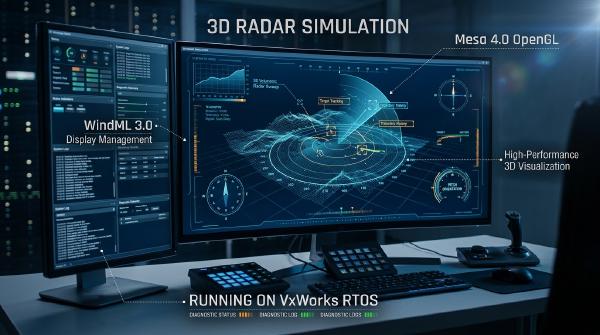
Leveraging Mesa for Enhanced GUI Rendering in WindML on VxWorks
When developing high-performance embedded systems on VxWorks, the quality of the Graphical User Interface (GUI) often dictates the usability of the final product. WindML3.0 serves as a primary framework for these interfaces, but standard rendering methods sometimes fall short when complex visual effects or high-fidelity graphics are required. Integrating the Mesa 3D graphics library offers a path to overcome these limitations.
🏗️ Overview of WindML and Rendering Constraints #
WindML is designed to streamline GUI development within the VxWorks environment. However, as embedded systems move toward more sophisticated visual requirements, the underlying rendering engine must handle more than just basic 2D widgets. Developers often encounter bottlenecks when trying to achieve smooth animations or complex geometric rendering using standard software-based drawing routines.
The primary challenge lies in the overhead of calculating pixel data for complex shapes in real-time. Without a dedicated graphics library, the CPU spends excessive cycles on rasterization, which can jitter the UI or impact the performance of real-time tasks.
🛠️ Integrating Mesa into the WindML3.0 Framework #
Mesa is an open-source implementation of the OpenGL API. By incorporating Mesa into the WindML3.0 framework, we shift the heavy lifting of graphics computation to a more optimized pipeline. This integration allows the system to leverage standardized 3D graphics instructions to render 2D and 3D elements.
Analysis of Test Issues #
During the testing phase of WindML3.0, several specific display issues were identified:
- Inconsistent frame rates during high-frequency UI updates.
- Limited support for complex transparency and alpha blending.
- Difficulty in rendering non-standard geometric shapes without significant manual coding.
The Mesa Solution #
By applying Mesa, the WindML framework gains access to a mature graphics stack. Instead of manually calculating every vertex and pixel, the developers can define the desired visual output through OpenGL calls. Mesa handles the translation of these calls into efficient rendering commands. This approach stabilizes the frame rate and provides a more consistent visual experience across different hardware configurations.
📈 Performance Gains and Implementation Results #
The application of Mesa in WindML3.0 successfully addressed the identified display bottlenecks. The integration provides a structured way to handle graphics, ensuring that the GUI remains responsive even when rendering complex elements.
Key Improvements #
- Rendering Efficiency: Mesa optimizes the rasterization process, reducing the CPU load per frame.
- Visual Fidelity: The framework now supports more sophisticated display effects, including better handling of overlapping elements and complex textures.
- Development Velocity: Developers can use standard OpenGL techniques rather than writing custom, low-level drawing code for every new UI component.
The results confirm that using Mesa as a backend for WindML3.0 significantly improves the embedded GUI’s display effect, meeting the requirements for high-quality, real-time visual feedback in industrial and marine applications.