VxWorks Network Communication with a Multi-Task Socket Server

🚀 1. Introduction #
Reliable network communication is an essential requirement for modern embedded real-time systems. Applications such as industrial automation, scientific instrumentation, communications equipment, and distributed control systems frequently need to exchange data with host computers, remote terminals, and other embedded devices.
VxWorks provides a mature real-time operating system environment with integrated TCP/IP networking capabilities and a BSD-compatible Socket API. Combined with its priority-based multi-tasking architecture, these features provide a practical foundation for developing responsive and concurrent network applications.
Rather than implementing an entire network service within a single task, developers can divide communication responsibilities among several cooperating tasks. For example, separate tasks can handle connection establishment, data transmission, data reception, periodic communication, user input, and network-status monitoring.
This approach improves modularity and allows individual communication functions to execute independently under the VxWorks scheduler.
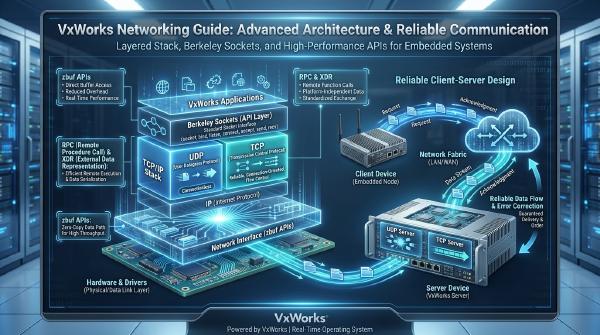
This article examines the essential multi-task programming interfaces available in VxWorks, introduces the BSD Socket programming model, and presents a practical multi-task server architecture for communication between a VxWorks embedded target and a host PC or another real-time system.
⚙️ 2. VxWorks Multi-Task Programming and Network Interfaces #
2.1 Task Management in VxWorks #
VxWorks uses a priority-based preemptive scheduling model. Each task is assigned a unique task ID, which the kernel uses to identify and manage its execution.
In the traditional VxWorks task scheduling model, 256 priority levels are available:
- Priority 0 represents the highest priority.
- Priority 255 represents the lowest priority.
A higher-priority task can preempt a lower-priority task when it becomes ready to execute. This scheduling mechanism allows embedded applications to assign appropriate priorities to communication, monitoring, and real-time control activities.
The commonly used task management functions include:
| Function | Purpose |
|---|---|
taskSpawn() |
Creates and starts a new task |
taskDelete() |
Terminates a task |
taskNameToId() |
Converts a task name into its task ID |
taskIdVerify() |
Verifies whether a task ID identifies a valid task |
taskPrioritySet() |
Changes the priority of an existing task |
taskPriorityGet() |
Retrieves the current priority of a task |
Tasks executing at the same priority can share CPU execution time through the kernel’s round-robin scheduling mechanism, configured using kernelTimeSlice().
For network applications, task priorities should be selected according to functional deadlines and execution requirements. Blocking network operations should generally remain outside time-critical control tasks so that unpredictable communication delays do not interfere with deterministic system activities.
2.2 Network Interface and Ethernet Driver Support #
VxWorks provides networking support through its TCP/IP stack and hardware-dependent Ethernet drivers.
Depending on the processor architecture, BSP, and VxWorks release, supported network controllers may include devices from manufacturers such as:
- Novell/NE2000-compatible Ethernet controllers.
- 3Com EtherLink III.
- Intel EtherExpress PRO/100B.
- AMD 79C972.
For legacy VxWorks development environments, the appropriate network driver and related networking components are commonly selected through BSP configuration files such as config.h.
The exact configuration process depends on the operating system version and target hardware. In newer VxWorks development environments, networking components and drivers are generally managed through the corresponding platform and image configuration tools.
Before implementing application-level Socket communication, developers should verify that the Ethernet driver is correctly initialized, the network interface is operational, and the target has valid IP connectivity.
2.3 BSD Socket Programming Interface #
One of the major advantages of VxWorks networking is its support for the BSD Socket programming model.
Developers familiar with UNIX or Linux network programming can reuse much of their existing Socket programming experience when developing VxWorks applications.
The principal BSD Socket functions are summarized below:
| Function | Purpose |
|---|---|
socket() |
Creates a communication endpoint |
bind() |
Associates a socket with a local IP address and port |
listen() |
Places a socket into passive listening mode |
connect() |
Establishes a connection with a remote endpoint |
accept() |
Accepts an incoming client connection |
send() |
Transmits data through a connected socket |
recv() |
Receives data from a connected socket |
close() |
Closes a socket and releases its associated resources |
These interfaces support common network communication models, including TCP and UDP.
For connection-oriented TCP applications, the typical communication sequence is as follows.
Server-side operations:
- Call
socket()to create a server socket. - Call
bind()to associate the socket with the desired local IP address and port. - Call
listen()to enable incoming connection requests. - Call
accept()to wait for and establish a client connection. - Use
send()andrecv()to exchange application data. - Call
close()when communication is complete.
Client-side operations:
- Call
socket()to create a client socket. - Call
connect()to establish a connection with the server. - Exchange data through
send()andrecv(). - Call
close()to terminate the connection.
Once the connection has been established, both endpoints can transmit and receive data independently.
For a practical introduction to TCP client-server implementation, see Networking with VxWorks: Socket Programming Basics.
🏗️ 3. Multi-Task Network Server Architecture #
3.1 Architectural Overview #
A network server running on VxWorks can be implemented as several independent but coordinated tasks.
The architecture described here uses a task-based design in which each task performs a specific communication or monitoring function.
The proposed server consists of eight principal tasks:
| Task Name | Responsibility |
|---|---|
tInit |
Network and server initialization |
tAccept |
Incoming connection management |
tAcpWatch |
Connection-task supervision and keyboard monitoring |
tSend |
Outgoing data transmission |
tRecv |
Incoming data reception |
tSendTimer |
Periodic timer management |
tSendOnTime |
Scheduled or timed data transmission |
tNetWatch |
Network-status monitoring and fault recovery |
This decomposition separates connection management from data processing and system supervision.
It also makes individual tasks easier to develop, test, and maintain.
3.2 Initialization Task: tInit #
The tInit task is responsible for preparing the network communication environment.
Its primary responsibilities include:
- Initializing application-level network parameters.
- Creating the server listening socket.
- Binding the socket to the configured IP address and port.
- Enabling incoming connection requests through
listen(). - Creating the connection-acceptance task.
- Starting the network monitoring task.
- Initializing shared connection-state variables and shutdown flags.
After successful initialization, tInit transfers control to the other tasks.
If socket creation, binding, or listening fails, the initialization procedure should report the error and release any resources already allocated rather than starting the server with an invalid network configuration.
3.3 Connection Acceptance Task: tAccept #
The tAccept task manages incoming client connections.
Its primary operation is to wait for connection requests by calling accept() on the listening socket.
When a client successfully connects, the server receives a new connected socket descriptor. This descriptor is used for subsequent communication with that specific client.
The acceptance task then creates the corresponding communication tasks:
- A
tSendtask for outgoing data. - A
tRecvtask for incoming data. - A
tSendTimertask for periodic timing operations. - A
tSendOnTimetask for scheduled transmissions. - Associated monitoring or supervision functions when required.
After creating the necessary tasks, tAccept returns to the accept() operation and continues waiting for additional client connections.
This arrangement allows the server to maintain multiple client sessions, provided that each session has its own communication state and appropriately managed resources.
For systems with a limited number of clients, a dedicated task pair for each connection is relatively straightforward to implement.
For systems requiring a larger number of simultaneous connections, a socket multiplexing approach using select() may provide better resource efficiency.
3.4 Connection Supervision and Keyboard Monitoring: tAcpWatch #
The tAcpWatch task supervises connection-management operations and handles local keyboard input.
Its responsibilities include:
- Monitoring user commands.
- Detecting requests to terminate the server.
- Coordinating acceptance-task shutdown.
- Initiating orderly connection cleanup when necessary.
For example, pressing the Escape key can be interpreted as a request to stop accepting new client connections.
Rather than immediately deleting a running task, the monitoring task should preferably signal the acceptance task to exit its blocking operation and perform its own cleanup. This prevents partially completed operations and reduces the risk of leaking socket resources.
3.5 Data Transmission Task: tSend #
The tSend task handles outgoing communication from the VxWorks target to a connected client.
Its main responsibilities include:
- Receiving local user input or application-generated data.
- Preparing the outgoing message.
- Transmitting data through the connected socket using
send(). - Detecting transmission errors.
- Handling commands that request session termination.
In the original interactive design, keyboard input is used as the source of outgoing messages. The Escape key can terminate the current communication session.
In a production embedded system, however, outgoing data would normally originate from application modules, sensor-processing tasks, or message queues rather than directly from the console.
A message queue or dedicated data-producer interface can help decouple data generation from network transmission.
An important consideration is that TCP provides a byte stream rather than application-level message boundaries. A successful send() operation does not necessarily transmit the entire requested buffer in one call. Therefore, the transmission implementation must handle partial writes and socket errors correctly.
When multiple tasks share a connected socket for transmission, access should also be serialized or assigned to a single transmission owner to prevent application messages from becoming interleaved.
3.6 Data Reception Task: tRecv #
The tRecv task continuously receives data from the connected client.
Its primary responsibilities include:
- Waiting for incoming network data.
- Receiving data through
recv(). - Passing received messages to the appropriate application logic.
- Displaying diagnostic information when required.
- Detecting remote disconnections.
- Processing application-specific commands.
For example, the server may use the string quit as an application-level command to terminate the current communication session.
When this command is received, the task can notify the session manager that the connection should be closed.
However, because TCP does not preserve individual application message boundaries, a single recv() call may return only part of a message or several messages together.
Consequently, command processing should use an explicit framing mechanism, such as newline delimiters, fixed-length messages, or length-prefixed packets. The application should also ensure that received data is correctly bounded and validated before processing.
When recv() returns zero, the remote endpoint has performed an orderly shutdown of its sending side. A negative return value indicates an error that must be evaluated according to the applicable socket error conditions.
3.7 Periodic Transmission Tasks: tSendTimer and tSendOnTime #
Some embedded network applications require data to be transmitted at regular intervals rather than only in response to external events.
The tSendTimer and tSendOnTime tasks provide a mechanism for implementing these operations.
Their responsibilities are divided as follows:
tSendTimer
- Maintains the timing mechanism.
- Generates periodic transmission events.
- Notifies the appropriate communication task when a transmission is due.
tSendOnTime
- Waits for scheduled transmission events.
- Retrieves the data that needs to be transmitted.
- Sends periodic messages through the connected socket.
- Handles transmission failures and timing-related exceptions.
This architecture can support periodic status reporting, heartbeat messages, remote monitoring updates, and other scheduled communication functions.
For real-time applications, periodic transmission should be implemented with appropriate timing primitives and carefully selected task priorities. The communication workload must not interfere with higher-priority control activities.
3.8 Network Monitoring and Fault Recovery: tNetWatch #
The tNetWatch task supervises network-related tasks and coordinates fault recovery.
Network failures can occur because of physical link disconnections, remote endpoint failures, socket errors, or unexpected task termination.
The monitoring task is responsible for identifying abnormal conditions and initiating the appropriate recovery procedure.
Typical operations include:
- Monitoring the status of active client connections.
- Checking communication-task execution states.
- Detecting socket errors and connection failures.
- Supervising task termination.
- Releasing resources associated with disconnected clients.
- Restarting the acceptance service when required.
- Coordinating orderly server shutdown.
When a communication failure occurs, the recovery procedure should follow a controlled sequence:
- Identify the affected client session.
- Notify the associated communication tasks.
- Stop further data transmission.
- Close the connected socket.
- Release session-specific resources.
- Update the connection state.
- Restore the server to an appropriate operating state.
Task existence checks such as taskIdVerify() can help identify terminated tasks, but they are not sufficient to determine whether a task is blocked indefinitely or making progress. Production implementations should combine task-state monitoring with socket error handling, communication timeouts, and application-level heartbeat mechanisms.
🔄 4. Inter-Task Synchronization and Console Input Management #
4.1 Shared Resource Protection #
Although dividing network functionality among multiple tasks improves modularity, it also introduces synchronization requirements.
Several tasks may need access to shared resources, including:
- Listening and connected socket descriptors.
- Client connection information.
- Communication buffers.
- Server shutdown flags.
- Session status information.
- Timer-related variables.
Unprotected concurrent access can result in race conditions, inconsistent application state, and unexpected socket behavior.
VxWorks provides several synchronization mechanisms that can be used to coordinate these tasks:
Semaphores
Binary and mutual-exclusion semaphores can protect shared resources and coordinate access to critical sections.
Message Queues
Message queues provide a structured mechanism for transferring commands and data between tasks. They are particularly useful for separating application processing from network input and output.
Task Synchronization
Tasks can coordinate their execution through appropriate kernel synchronization facilities, including semaphores and other task-control mechanisms supported by the target VxWorks release.
For this server architecture, a practical design is to assign ownership of each client socket to a session manager and use message queues or semaphores to coordinate the associated worker tasks.
This approach makes socket ownership and resource cleanup easier to control.
4.2 Console Input and the VxWorks Shell #
Interactive network applications sometimes need to read keyboard input while the VxWorks shell (tShell) is active.
This introduces a potential conflict because the shell and application tasks may compete for access to the same console input device.
Simply changing task priorities does not provide a reliable solution to shared console ownership. Multiple tasks independently reading from the same input stream can still produce unpredictable behavior.
Several approaches are available:
-
Use a dedicated console-input task. Only one task reads keyboard input and distributes commands to other tasks through message queues.
-
Use a separate input device or communication channel. This avoids conflicts with the interactive shell.
-
Configure a dedicated embedded deployment without an interactive shell. This allows the application to manage console or serial input directly when appropriate.
-
Use explicit device I/O operations. Functions such as
read()andwrite()can be used with the appropriate console device descriptor and access configuration.
For laboratory development systems, a dedicated keyboard-input task is generally preferable to allowing multiple network tasks to read from the console independently.
🛡️ 5. Reliability and Performance Considerations #
A multi-task network server must be designed with the scheduling behavior and resource limitations of an embedded real-time operating system in mind.
Several engineering considerations are particularly important.
5.1 Task Priority and Scheduling #
Network communication tasks should receive priorities appropriate to their processing deadlines.
Time-critical control functions should generally execute at higher priorities than non-critical network monitoring or console-display operations.
Excessively high network-task priorities can negatively affect the responsiveness of other real-time functions, especially when communication operations involve blocking calls or substantial data processing.
5.2 Socket Error Handling #
Every important Socket operation should have explicit error handling.
In particular, the application should account for:
- Socket creation failures.
- Binding and listening failures.
- Interrupted or unsuccessful connection acceptance.
- Partial data transmission.
- Remote connection termination.
- Receive timeouts.
- Unexpected socket errors.
TCP applications should also implement proper message framing because the network transport does not guarantee that one send() operation corresponds to one recv() operation.
5.3 Connection Limits and Resource Management #
Creating a separate pair of worker tasks for every client connection provides a simple programming model, but it increases memory consumption and task-management overhead as the number of clients grows.
Embedded implementations should establish reasonable limits for:
- Simultaneous client connections.
- Task stack sizes.
- Communication buffer sizes.
- Socket descriptors.
- Session timeouts.
When the expected connection count becomes large, alternatives such as task pools or socket multiplexing can improve scalability.
5.4 Controlled Shutdown and Recovery #
A server should use a defined shutdown protocol rather than deleting communication tasks arbitrarily.
The preferred procedure is to signal the affected tasks, allow them to exit their processing loops, close their owned sockets, release synchronization resources, and report completion to the session manager.
This is particularly important when a socket is shared among transmission, reception, and monitoring functions.
A centralized connection manager can simplify this process and prevent multiple tasks from independently closing the same socket or accessing resources after they have been released.
🔗 6. Related VxWorks Network Programming Resources #
For developers extending this multi-task architecture, the following technical references provide additional guidance:
-
Networking with VxWorks: Socket Programming Basics — Covers the BSD Socket programming model and TCP client-server implementation in VxWorks.
-
Handling Multiple Clients in VxWorks with select() — Explains how socket multiplexing can be used to monitor multiple client connections without creating a dedicated task for every connection.
These approaches provide complementary solutions: task-per-connection designs are straightforward for a small number of clients, while select()-based designs can reduce task overhead when managing multiple simultaneous connections.
🎯 7. Conclusion #
Combining VxWorks multi-task programming capabilities with the BSD Socket API provides an effective foundation for implementing network communication in embedded real-time systems.
By dividing server functionality into specialized tasks for initialization, connection acceptance, data transmission, data reception, periodic communication, and network monitoring, developers can build a modular communication architecture that supports concurrent operations.
The proposed design also demonstrates the importance of inter-task synchronization, socket lifecycle management, task scheduling, and controlled fault recovery.
For laboratory instrumentation systems and other embedded applications that exchange data with host PCs or remote real-time nodes, this architecture offers a practical balance between implementation simplicity, communication responsiveness, and maintainability.
With appropriate synchronization, error handling, resource management, and task-priority configuration, a multi-task VxWorks network server can provide a reliable foundation for more sophisticated embedded communication services.