Building a Custom VxWorks Network Stack: A Developer’s Guide
Real-time embedded systems often impose networking requirements that go beyond conventional TCP/IP communication. Aerospace, defense, telecommunications, industrial automation, and autonomous systems may require deterministic packet handling, tightly controlled latency, specialized protocols, and hardware-specific optimizations.
VxWorks, Wind River’s real-time operating system (RTOS), provides a modular networking environment that supports standard IP communication, hardware-specific network drivers, and integration with application-level middleware. Its VxBus and Enhanced Network Driver (END) frameworks provide important integration points for custom networking hardware.
Building a custom network stack does not necessarily mean replacing the entire TCP/IP implementation. In many projects, the more maintainable approach is to extend the existing networking environment with a custom network driver, introduce a protocol through supported interfaces, or implement domain-specific communication logic above the socket layer.
This guide explains the architecture, development workflow, implementation considerations, and testing strategies involved in customizing networking on VxWorks 7. It also highlights important distinctions between application-level protocol development, network driver development, and modifications to the underlying protocol stack.
For an overview of the hardware-integration process, see the VxWorks 7 BSP Development Guide, which discusses board support package development and network drivers built around the END framework.
🎯 Why Build a Custom Network Stack on VxWorks? #
VxWorks provides a networking environment that supports conventional embedded communication requirements. However, specialized systems may require functionality or performance characteristics that cannot be achieved efficiently through the default configuration alone.
The appropriate customization depends on whether the limitation lies in the application protocol, network driver, operating system configuration, or underlying hardware.
Performance Optimization #
Applications such as industrial motion control, avionics communication, and time-sensitive data acquisition may require predictable packet-processing latency and bounded processing overhead.
Potential optimizations include reducing unnecessary packet copies, improving DMA buffer management, controlling task priorities, and separating time-critical packet processing from background operations.
A custom implementation may also be necessary when the target hardware exposes specialized features that the standard driver does not fully utilize.
However, low average latency does not guarantee deterministic behavior. Interrupt interference, task scheduling, lock contention, memory allocation, and queue congestion must also be evaluated.
Lightweight Networking #
Resource-constrained controllers and embedded devices may not require the full functionality of a general-purpose TCP/IP stack.
A smaller protocol implementation can reduce memory consumption, initialization complexity, and the number of enabled services. This approach is appropriate only when the application can operate within the resulting protocol limitations and the implementation satisfies its reliability and security requirements.
Before developing a replacement stack, verify whether the existing VxWorks networking configuration can be reduced to the required set of components.
Proprietary and Specialized Protocols #
Some embedded systems require domain-specific protocols for communication between custom hardware, controllers, and other devices.
Examples include proprietary telemetry formats, specialized industrial protocols, application-specific message framing, and deterministic communication schemes.
A custom protocol can often be implemented above an existing transport or through a supported lower-level interface. Replacing IP networking entirely should be reserved for requirements that cannot be satisfied through those approaches.
Specialized Hardware Integration #
Custom Ethernet controllers, FPGA-based packet-processing engines, and SoC-specific MAC implementations may require driver development beyond the facilities provided by the existing BSP.
VxBus provides device discovery and hardware-resource management capabilities, while the END framework integrates supported network interfaces with the networking subsystem.
Developers can use these frameworks to integrate custom hardware without rewriting unrelated parts of the TCP/IP implementation.
Security and Protocol Control #
A specialized communication environment may require strict control over supported protocols, message formats, authentication, and encryption.
A custom network component can enforce domain-specific validation and communication policies. Nevertheless, security-sensitive systems should use established cryptographic algorithms and protocols rather than introducing proprietary encryption without rigorous analysis.
A custom network stack should reduce the attack surface while preserving necessary security mechanisms, not merely remove components from the implementation.
🧩 Understanding the VxWorks Networking Architecture #
Before modifying networking functionality, identify the layer responsible for the requirement.
A typical VxWorks networking architecture includes application interfaces, protocol-processing components, network-interface integration, and hardware-specific drivers.
The exact components and interfaces depend on the VxWorks version and configuration.
Socket and Application Layer #
Applications commonly use BSD-compatible socket interfaces to communicate over supported network protocols.
Typical operations include:
socket()to create a communication endpoint.bind()to associate a local address or port.connect()to establish or initiate communication.send()andrecv()to exchange data.sendto()andrecvfrom()for connectionless communication.select()or other supported mechanisms to monitor I/O readiness.
Middleware such as HTTP servers, SNMP agents, messaging frameworks, and DDS implementations may sit above the socket or transport layer.
When the requirement concerns application message formats, telemetry encoding, or communication state machines, implementing the functionality at this level is generally preferable to modifying the underlying IP stack.
TCP/IP Protocol Stack: IPNet and IPCOM #
VxWorks networking configurations may include IPNet and IPCOM components for IP connectivity and associated network services.
IPNet provides core IP networking functionality, including applicable transport, routing, and IPv6 capabilities. IPCOM provides supporting networking services and utilities, depending on the installed configuration.
These components should be treated as version-specific platform facilities. Their internal interfaces are not automatically stable or supported extension points for arbitrary custom protocols.
Before adding a protocol handler directly to the stack, verify that the relevant VxWorks release provides a documented integration mechanism or that Wind River explicitly supports the intended modification.
If the custom functionality can be implemented through sockets, a supported packet interface, or an application-level protocol layer, doing so usually reduces maintenance costs and improves compatibility with future platform updates.
Network Interface Layer: MUX and END #
The network-interface layer connects the networking subsystem to the underlying hardware driver.
The MUX interface provides the network-stack integration mechanism used by END drivers in applicable VxWorks configurations. An END driver implements the operations needed to control the network interface and transmit and receive frames.
Typical driver responsibilities include:
- Initializing and shutting down the network interface.
- Managing transmit and receive descriptors.
- Transferring packet buffers between software and hardware.
- Processing device interrupts and deferred work.
- Reporting interface state and link status.
- Supporting relevant configuration and control operations.
The exact callback definitions, registration procedures, and buffer-management requirements must be taken from the headers and documentation supplied with the selected VxWorks release.
For a deeper explanation of the relationship between IPNet, IPCOM, MUX, and END, see the VxWorks 6.6 Network Stack and END Driver Architecture guide. Although it covers VxWorks 6.6, it provides useful historical context; confirm all APIs against the VxWorks 7 documentation used by your project.
Hardware and BSP Layer #
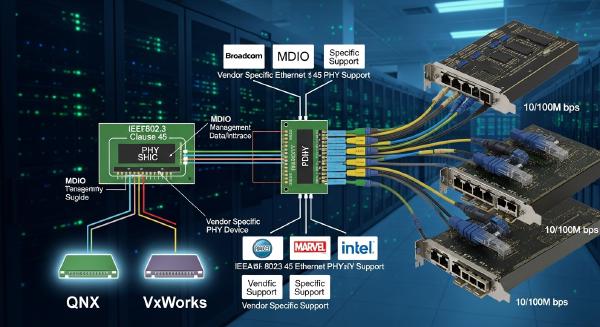
The hardware layer includes the Ethernet MAC, PHY, DMA engine, device registers, and any associated FPGA or SoC-specific components.
The BSP establishes platform-specific initialization and exposes the hardware resources required by drivers.
VxBus can help discover and manage supported devices, while the END driver supplies the network-interface functionality expected by the configured networking stack.
For custom NIC hardware, verify:
- Register mappings and access requirements.
- DMA address and alignment restrictions.
- Cache-coherency requirements.
- Interrupt routing and acknowledgement behavior.
- PHY initialization and link negotiation.
- Descriptor-ring layout and ownership rules.
- Hardware limitations affecting packet size or offload capabilities.
The interaction among these layers determines the actual behavior of the network interface under load.
🛠️ Step-by-Step: Building a Custom Network Solution #
The development process should begin by determining whether the requirement calls for a new application protocol, a network driver, or a replacement protocol implementation.
That distinction prevents unnecessary changes to core operating-system components.
Step 1: Define the Networking Requirements #
Document the expected behavior before making implementation decisions.
Important requirements include:
| Requirement | Questions to resolve |
|---|---|
| Latency | What are the average, tail, and worst-case response-time targets? |
| Throughput | What sustained and peak packet rates must be supported? |
| Protocols | Are TCP, UDP, IPv4, IPv6, or a proprietary protocol required? |
| Packet sizes | What are the minimum, typical, and maximum message sizes? |
| Reliability | How should packet loss, link failure, and retransmission be handled? |
| Security | Are authentication, encryption, integrity verification, or segmentation required? |
| Resources | What are the CPU, memory, and buffer budgets? |
| Compatibility | Must the solution integrate with existing IPNet applications and middleware? |
For example, a requirement for deterministic telemetry delivery does not necessarily justify replacing the TCP/IP stack. A custom telemetry protocol over UDP or another supported transport may be sufficient.
Conversely, a specialized Ethernet interface or hardware-assisted packet-processing requirement may require a custom END driver or lower-level integration.
Step 2: Set Up the VxWorks Development Environment #
The development environment should include the toolchain, VSB, VIP, and BSP appropriate for the target system.
Typical prerequisites include:
- VxWorks 7 and a compatible development SDK or Workbench installation.
- A BSP supporting the target processor and required hardware.
- The networking components needed by the application.
- The appropriate compiler, linker, and library configuration.
- Debugging facilities such as WRDBG, the kernel shell, or System Viewer.
- Test hardware or a supported simulation environment.
Build the VSB and VIP with the necessary networking components enabled.
If the project uses a generated SDK, initialize its environment before compiling custom components. Ensure that the headers and libraries match the target kernel configuration.
For network driver development, refer to the VxWorks 7 BSP Development Guide, which provides an END-driver-oriented workflow.
Step 3: Implement a Custom Network Driver #
When the requirement involves unsupported hardware, driver development is often the appropriate starting point.
A VxBus-aware implementation should follow the device lifecycle and resource-management conventions documented for the target BSP. Its END integration must conform to the interfaces expected by the configured VxWorks networking subsystem.
A typical driver has several functional responsibilities:
- Discover or initialize the device.
- Allocate and configure descriptor rings and packet buffers.
- Initialize the MAC and PHY.
- Register the network interface using the supported driver framework.
- Start and stop packet transmission and reception.
- Handle interrupts and deferred processing.
- Report interface state and respond to supported control requests.
The following C-like example illustrates the conceptual division of responsibilities. It is illustrative pseudocode, not a drop-in VxWorks driver; actual END structures, callback signatures, and registration procedures must match the installed SDK.
/*
 * Illustrative pseudocode only.
 *
 * A production implementation must use the END and VxBus
 * interfaces documented for the target VxWorks release.
 */

STATUS myNicDriverInitialize(MY_NIC *nic)
{
    if (nic == NULL)
    {
        return ERROR;
    }

    /*
     * Discover hardware resources, initialize the MAC/PHY,
     * and configure DMA descriptors and buffer pools.
     */
    if (nicHardwareInitialize(nic) != OK)
    {
        return ERROR;
    }

    /*
     * Register the interface through the supported END
     * framework and initialize its transmit/receive paths.
     */
    if (nicRegisterEndInterface(nic) != OK)
    {
        nicHardwareShutdown(nic);
        return ERROR;
    }

    return OK;
}

STATUS myNicDriverStart(MY_NIC *nic)
{
    if (nic == NULL)
    {
        return ERROR;
    }

    /*
     * Enable the required interrupt sources and start
     * receive/transmit processing in the documented order.
     */
    if (nicStartHardware(nic) != OK)
    {
        return ERROR;
    }

    return OK;
}
The example deliberately leaves out the release-specific END and VxBus implementation details.
Transmit Processing #
The transmit path receives a packet from the networking subsystem and prepares it for hardware transmission.
Typical operations include:
- Validating packet length and descriptor availability.
- Mapping packet buffers for DMA when required.
- Applying the platform’s cache-maintenance rules.
- Populating hardware descriptors.
- Updating descriptor ownership and notifying the device.
- Reclaiming completed descriptors and buffers.
Packets should not be released while the NIC may still access them through DMA. Buffer ownership must be tracked explicitly to prevent use-after-free errors, packet corruption, and memory leaks.
Receive Processing #
The receive path obtains completed packets from the device’s descriptor ring and delivers them through the expected interface.
The driver needs to validate received lengths, replenish receive buffers, maintain cache coherency, and transfer ownership to the appropriate software component.
Malformed frames, descriptor exhaustion, DMA errors, and link-state changes should be handled without corrupting descriptor state or blocking unrelated networking operations.
The design should also account for backpressure. If the networking subsystem cannot process packets at the incoming rate, the driver needs a documented queueing and drop policy.
Interrupt Handling #
The interrupt service routine should perform only the operations necessary to acknowledge the hardware event and schedule further work.
Lengthy packet processing belongs in an appropriate deferred context rather than the ISR itself. This reduces interrupt duration and makes system responsiveness easier to analyze.
The correct approach may include task-level processing, a deferred execution mechanism, or another facility supported by the BSP. Follow the synchronization and execution-context constraints of the relevant VxWorks APIs.
Step 4: Extend the Protocol Layer #
If the hardware driver already works but the application requires a custom protocol, consider implementing the protocol above the existing network stack.
An application-level protocol can use a socket interface to define message framing, sequence numbers, authentication, acknowledgements, and state-machine behavior.
For example, the following simplified UDP server receives a datagram and validates its application-specific message header. It demonstrates the application-level approach rather than attempting to insert an undocumented handler into IPNet.
#include <stdio.h>
#include <string.h>
#include <sys/socket.h>
#include <netinet/in.h>
#include <arpa/inet.h>

#define TELEMETRY_PORT 41000
#define MAX_PACKET_SIZE 2048

#define TELEMETRY_MAGIC 0x544C4D31U

typedef struct
{
    unsigned int magic;
    unsigned int sequence;
    unsigned int payloadLength;
} TELEMETRY_HEADER;

static int processTelemetry(const unsigned char *payload,
                            unsigned int length)
{
    /*
     * Validate and process application data here.
     * Do not trust the sender or the header fields.
     */
    (void)payload;
    (void)length;
    return 0;
}

int telemetryServer(void)
{
    int fd;
    struct sockaddr_in addr;
    unsigned char buffer[MAX_PACKET_SIZE];

    fd = socket(AF_INET, SOCK_DGRAM, 0);
    if (fd < 0)
    {
        return -1;
    }

    memset(&addr, 0, sizeof(addr));
    addr.sin_family = AF_INET;
    addr.sin_port = htons(TELEMETRY_PORT);
    addr.sin_addr.s_addr = htonl(INADDR_ANY);

    if (bind(fd, (struct sockaddr *)&addr, sizeof(addr)) < 0)
    {
        close(fd);
        return -1;
    }

    for (;;)
    {
        ssize_t received = recvfrom(
            fd, buffer, sizeof(buffer), 0, NULL, NULL
        );

        if (received < 0)
        {
            /*
             * Apply the application's retry, error-reporting,
             * and shutdown policy here.
             */
            continue;
        }

        if ((size_t)received < sizeof(TELEMETRY_HEADER))
        {
            continue;
        }

        TELEMETRY_HEADER header;
        memcpy(&header, buffer, sizeof(header));

        /*
         * A real protocol must define wire byte order and
         * validate all fields before using them.
         * This example omits conversion for brevity.
         */
        if (header.magic != TELEMETRY_MAGIC)
        {
            continue;
        }

        if (header.payloadLength !=
            (unsigned int)((size_t)received -
                           sizeof(TELEMETRY_HEADER)))
        {
            continue;
        }

        processTelemetry(
            buffer + sizeof(TELEMETRY_HEADER),
            header.payloadLength
        );
    }

    /* Unreachable in this simplified server. */
    close(fd);
    return 0;
}
This example is a starting point for a small application protocol, not production-ready telemetry software. A production implementation should define portable wire encoding, byte-order conversions, message versioning, authentication, resource limits, and a controlled shutdown mechanism.
If a new protocol must operate inside IPNet itself rather than over an existing transport, use only the documented extension points available for the target release or obtain the necessary guidance from Wind River. Direct modifications to internal protocol dispatchers can create compatibility and maintenance problems.
Step 5: Optimize for Real-Time Performance #
Performance tuning should follow measurement rather than assumptions. First establish a working implementation, then identify the component responsible for the observed latency or throughput limitation.
Zero-Copy Buffer Management #
Packet copies consume CPU time and memory bandwidth. Where supported, zero-copy or reduced-copy techniques can allow data to move between the networking stack and hardware using shared buffer ownership.
VxWorks networking drivers commonly work with framework-defined packet buffers and clusters, including structures associated with M_BLK and CL_BLK management in relevant configurations.
A custom implementation must respect the documented buffer ownership rules and allocation interfaces. Incorrectly reusing buffers can corrupt packets or allow hardware and software to access the same memory inconsistently.
Zero-copy designs should also consider DMA alignment, cache invalidation, memory barriers, descriptor ownership, and buffer-pool exhaustion.
Task Priorities and CPU Affinity #
Network processing tasks may need carefully selected priorities to meet application timing requirements.
However, assigning excessive priority to network tasks can starve other critical workloads. CPU affinity can also improve cache locality in certain systems, but may reduce flexibility when interrupt activity or traffic distribution is unbalanced.
Tune scheduling based on end-to-end requirements, including the processing needed after a packet reaches the application.
Interrupt and Deferred Processing #
Keep the ISR short and predictable. Avoid blocking operations, dynamic memory allocation, and extensive protocol parsing in interrupt context.
If the device and BSP support efficient interrupt moderation or batching, evaluate these features against the application’s latency requirements. Larger batches may improve throughput but increase the time before an individual packet is processed.
Socket and Queue Configuration #
Socket-buffer and driver-ring sizes affect burst handling, memory consumption, and queueing delay.
Larger queues can absorb short traffic bursts but may also hide congestion and increase tail latency. Smaller queues can reduce queueing delay but may drop packets under bursty workloads.
Choose queue sizes based on measured traffic patterns and the application’s tolerance for packet loss and delay.
Jumbo Frames and Hardware Offload #
Jumbo frames can reduce per-packet overhead for workloads that transfer large blocks of data, provided that all relevant links and endpoints support a compatible frame size.
Hardware offload features, such as checksum calculation or other NIC-supported operations, may reduce CPU cost. Their value depends on device capabilities, driver support, and the way the networking stack uses those features.
Do not enable offload options simply because the hardware exposes them. Verify correctness and measure performance with the exact workload.
🧪 Testing and Debugging the Custom Networking Implementation #
A custom network component needs validation across functional correctness, protocol compliance, performance, and failure recovery.
Runtime Inspection #
VxWorks provides shell commands and diagnostic facilities that can help inspect network interfaces and system state.
Where supported by the installed configuration, commands such as the following may be useful:
ifShow
netstat
muxShow
The availability and output of these commands vary by VxWorks release and included components.
Use the target’s documentation to identify the appropriate commands for inspecting interface configuration, routing, sockets, statistics, and driver state.
Packet-Level Validation with Wireshark #
Wireshark can verify packet headers, message sequencing, protocol framing, and the interaction between endpoints.
Capture traffic under both normal and abnormal conditions. Check malformed packets, missing messages, retransmissions, duplicate messages, unexpected fragmentation, and protocol-version differences.
For real-time protocols, packet captures should be supplemented with hardware timestamps or other suitable timing instrumentation when precise latency measurements are required.
Real-Time Profiling #
Use System Viewer or other supported profiling tools to understand scheduling behavior, interrupt duration, task execution, and synchronization overhead.
Useful measurements include:
- Packet arrival-to-processing latency.
- ISR execution duration.
- Task wake-up latency.
- Queue depth and buffer exhaustion.
- Packet drop rate under sustained load.
- Tail latency under competing CPU workloads.
- Recovery time after interface or link failure.
Average latency alone is insufficient for a deterministic system. Record latency distributions and evaluate the worst observed cases under a representative test plan.
Throughput and Stress Testing #
Tools such as iperf, where available for the target and host environments, can help measure throughput and identify bottlenecks.
A complete test plan should include:
- Sustained traffic at increasing packet rates.
- Small packets and maximum-supported frame sizes.
- Simultaneous transmit and receive traffic.
- Bursty traffic and queue saturation.
- Long-duration operation and memory-leak checks.
- Link failure, restoration, and repeated reconnection.
- Malformed packets and unexpected protocol inputs.
- CPU load and interrupt contention from other real-time tasks.
Testing should cover both the network driver and the complete application path. A fast interface driver does not guarantee fast end-to-end behavior if the protocol parser, scheduler, or application queue becomes the bottleneck.
🔐 Best Practices for Custom VxWorks Networking #
A maintainable implementation separates hardware-specific code, protocol behavior, and application logic.
Preserve Modularity #
Keep driver initialization, transmit and receive processing, protocol parsing, and application behavior in distinct modules.
This separation makes it easier to test individual components, replace hardware, and upgrade VxWorks without rewriting the entire implementation.
Reuse Supported VxWorks Interfaces #
Prefer the supported VxBus, END, socket, memory-management, and scheduling interfaces supplied by the target SDK.
Avoid dependence on undocumented internal functions unless the platform vendor explicitly supports the intended use. Internal interfaces can change between releases and may not preserve compatibility.
Design for Failure #
Network drivers should handle link loss, device resets, DMA errors, buffer exhaustion, and hardware timeouts.
Define recovery behavior explicitly. A driver that works under normal traffic but becomes stuck after a rare error is not suitable for a mission-critical real-time system.
Secure the Protocol #
Validate packet lengths, message types, sequence numbers, and other untrusted inputs before processing.
For security-sensitive communications, use established authentication and encryption mechanisms supported by the platform. Keep key management separate from protocol parsing and follow the system’s security architecture.
VxWorks’ broader security capabilities are described in the VxWorks safety, security, and reliability overview.
Automate Regression Testing #
Maintain repeatable tests for normal communication, error handling, throughput, timing, and recovery.
A hardware or BSP change can affect DMA behavior, interrupt timing, and packet-processing performance even when the protocol code remains unchanged. Regression testing is essential whenever the toolchain, kernel configuration, driver, or target hardware changes.
🏭 Real-World Applications #
Custom networking on VxWorks is relevant to several classes of embedded systems.
Aerospace and Defense #
Aircraft and defense systems may use deterministic communication protocols and tightly controlled network paths. Examples include avionics Ethernet implementations based on ARINC 664/AFDX and domain-specific communication interfaces.
Such systems have strict requirements for timing analysis, fault containment, and configuration control. A custom protocol or driver must be validated against the applicable system and certification requirements.
Industrial Automation #
Industrial controllers may need bounded communication delays for coordinated control, sensor acquisition, and machine-to-machine communication.
Where supported, industrial Ethernet technologies and Time-Sensitive Networking (TSN) can help provide traffic scheduling and synchronization facilities. Their real-time behavior still depends on end-to-end configuration, hardware support, and workload validation.
Telecommunications #
Network appliances and communication equipment may use hardware acceleration or custom interfaces to support high packet rates and specialized traffic-processing requirements.
In these cases, driver design, packet-buffer ownership, CPU scheduling, and hardware offloads can significantly affect the achievable performance.
Industrial IoT and Custom Hardware #
Embedded devices may combine sensors, FPGA-based data-processing logic, and custom MAC implementations. A VxBus-aware driver integrated through the supported network interface framework can expose the necessary networking capability to higher-level applications.
This approach allows hardware-specific behavior to remain separated from application protocols.
✅ Conclusion #
Building a custom network stack on VxWorks begins with identifying the actual networking requirement and selecting the correct integration layer.
A custom network driver is appropriate when the hardware is unsupported or the existing driver cannot meet the required behavior. An application-level protocol is often the better choice when only message framing, application semantics, or domain-specific communication must change. Modifications to the underlying IP stack should be limited to cases where the required functionality cannot be implemented through supported interfaces.
The essential engineering workflow is to define latency, throughput, reliability, security, and resource requirements; configure the matching VSB and VIP; implement the correct driver or protocol interface; measure performance; and test failure behavior under realistic conditions.
VxBus, END, and the existing networking facilities provide a foundation for building specialized embedded networking solutions, but reliable behavior still depends on careful buffer management, interrupt handling, scheduling, security controls, and hardware validation.
By preserving modularity and using documented interfaces wherever possible, developers can build a custom networking solution that meets real-time requirements without unnecessarily sacrificing compatibility, maintainability, or system reliability.