VxWorks RTOS: A Leading Commercial Platform for Embedded Systems
Modern embedded systems are expected to do considerably more than execute a few real-time tasks. Aerospace platforms need certifiable software, industrial controllers must coordinate increasingly complex machinery, automotive systems require predictable responses under heavy workloads, and spacecraft must continue operating reliably in environments where maintenance is impossible.
For engineering teams, choosing an operating system is therefore a long-term architectural decision. A real-time kernel alone is rarely enough. The platform must also provide mature hardware support, predictable scheduling, security mechanisms, development tools, lifecycle maintenance, and a practical path through industry-specific certification requirements.
This is where commercial real-time operating systems (RTOSes) have an advantage.
Wind River positions VxWorks as the embedded industry’s No. 1 commercial RTOS, drawing on decades of deployment across aerospace, defense, industrial automation, automotive, medical, and space applications. Its value is not simply that it can schedule tasks in real time. It provides a broader software foundation for developing, integrating, securing, and maintaining production embedded systems.
For developers building long-lived products, that distinction matters.
🚀 Why Choose a Commercial RTOS? #
Embedded development teams generally have three options: build an operating system internally, adopt an open-source RTOS, or use a commercial platform.
Each approach has its place. An internally developed kernel offers complete control but creates a substantial maintenance responsibility. Open-source systems provide flexibility and can reduce licensing costs, but the engineering organization remains responsible for integration, validation, long-term maintenance, and any required certification evidence.
A commercial RTOS offers a different model. The operating system comes with an established development organization, supported hardware configurations, engineering documentation, maintenance releases, and professional technical support.
Three characteristics are particularly relevant.
Modern Development Support #
A production RTOS must keep pace with changes in processors, programming languages, security requirements, communication protocols, and development workflows.
Developers increasingly expect support for modern C and C++ standards, reusable libraries, scripting environments, debugging tools, and automated build systems.
VxWorks has evolved beyond the traditional embedded development model built around a proprietary compiler and a small collection of target-side tools. Its development ecosystem supports contemporary programming practices while retaining the low-level control needed for deterministic applications.
Long-Term Platform Evolution #
Embedded products often remain in service for ten or twenty years, sometimes considerably longer.
During that period, processor families change, security vulnerabilities emerge, communication standards evolve, and hardware components reach end of life.
An established commercial RTOS vendor can provide maintained software releases, hardware migration support, security updates, and engineering assistance throughout the product lifecycle.
This reduces the risk of maintaining a platform that becomes increasingly difficult to modify or integrate with newer hardware.
Deterministic Execution #
Real-time behavior is a fundamental design requirement, not an optional feature.
A real-time operating system must provide predictable task scheduling, interrupt handling, synchronization, and communication behavior. Meeting a deadline matters more than achieving the highest average throughput.
VxWorks is designed for applications that require bounded response times and controlled execution behavior.
Of course, an RTOS alone cannot guarantee that an entire application meets its deadlines. Device drivers, interrupt latency, memory access, DMA activity, processor contention, and application-level resource management all affect timing. The complete execution path must be measured and validated.
🌍 Proven Across Safety-Critical Industries #
A commercial RTOS earns its reputation through production deployments, not feature lists. VxWorks has a long history in systems where software failures can have serious operational, financial, or safety consequences.
Its deployment experience spans several major industries.
Aerospace and Defense #
Avionics and defense systems impose demanding requirements on software reliability, timing behavior, fault isolation, and certification.
VxWorks is used in flight-control systems, avionics computers, radar platforms, communication equipment, and other mission-critical applications.
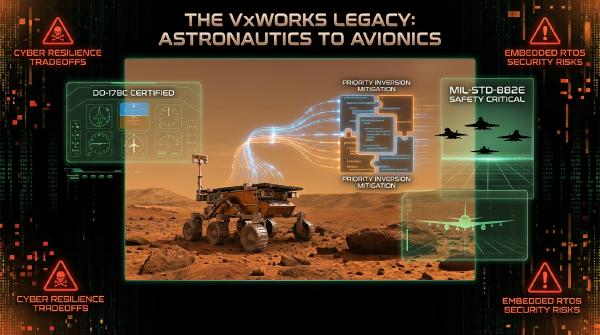
Safety-oriented offerings, including VxWorks Cert and VxWorks 653, support development programs targeting standards such as DO-178C. The platform also provides partitioning and multi-core capabilities for systems that need to consolidate applications with different safety-criticality levels.
For developers, the availability of established certification artifacts and a mature operating environment can reduce the amount of operating-system verification work that must be performed during system development.
Industrial Automation #
Industrial controllers must coordinate sensors, actuators, communication interfaces, and control algorithms under predictable timing constraints.
In robotic systems, for example, motion sequencing and feedback processing must occur within defined execution intervals. Unexpected scheduling delays can affect motion accuracy, process stability, and machine safety.
VxWorks has been deployed in industrial automation equipment, including robotics and intelligent manufacturing systems.
Its deterministic scheduling, hardware support, networking capabilities, and functional safety options make it suitable for applications that combine real-time control with increasingly sophisticated connectivity.
Space Exploration #
Space systems represent one of the clearest examples of why operating-system reliability matters.
Once a spacecraft has been launched, software faults cannot usually be corrected through ordinary hardware maintenance. The operating system and application software must operate within strict resource constraints and tolerate demanding environmental conditions.
VxWorks has been used in NASA missions, including the InSight Mars lander, demonstrating its role in long-duration space applications.
Such deployments place significant emphasis on predictable execution, hardware control, fault handling, and carefully validated software behavior.
Automotive and High-Performance Vehicles #
Automotive electronics continue to absorb more software functionality, from powertrain control and vehicle dynamics to advanced driver-assistance systems (ADAS) and digital cockpit platforms.
These applications require a combination of real-time performance, functional safety, cybersecurity, and support for increasingly powerful multi-core processors.
VxWorks has also been used in high-performance racing applications. In the automotive example highlighted by Wind River, a racing-car supplier reduced development time by using the mature operating-system software, development tools, and technical support available through the platform.
Across these industries, the common requirement is not simply fast execution. It is predictable behavior that engineering teams can integrate, test, maintain, and validate.
⚙️ Technical Foundations for Safety and Performance #
VxWorks provides a collection of operating-system services and development components designed for embedded applications with different performance and assurance requirements.
Its technical foundation combines a real-time kernel, hardware-specific BSPs, application runtime environments, networking and middleware components, and optional safety and security technologies.
Functional Safety and Certification Support #
Different industries use different functional safety standards.
The VxWorks portfolio supports development and certification activities associated with several major standards:
| Industry | Relevant standard | Safety scope |
|---|---|---|
| Aerospace | RTCA DO-178C | Airborne software assurance |
| Industrial | IEC 61508 | Functional safety |
| Automotive | ISO 26262 | Road vehicle functional safety |
| Medical | IEC 62304 | Medical device software lifecycle |
VxWorks Cert Edition provides a safety-oriented operating-system foundation and associated certification artifacts for programs targeting stringent requirements, including DO-178C DAL A, IEC 61508 SIL 3, ISO 26262 ASIL D, and IEC 62304 Class C.
The availability and applicability of certification evidence depend on the specific product edition, release, hardware platform, software configuration, and certification scope.
This distinction is important. Using a safety-oriented RTOS does not automatically certify the complete embedded product. The application, hardware, integration process, verification activities, and system-level safety case must still satisfy the applicable requirements.
Nevertheless, starting with an established RTOS and its supporting evidence can significantly reduce duplicated operating-system verification work.
Deterministic Scheduling and Performance #
VxWorks is designed to support real-time applications that require predictable task execution and low scheduling overhead.
Its scheduling and synchronization facilities allow developers to coordinate tasks according to application priorities and timing requirements.
Typical capabilities include:
- Priority-based task scheduling.
- Semaphore and mutual-exclusion management.
- Inter-task message queues.
- Interrupt management.
- Timer and clock services.
- Memory management.
- Symmetric multiprocessing (SMP) support on supported platforms.
- Time and space partitioning in applicable configurations.
For multi-core applications, developers must also account for shared-resource contention, cache behavior, interrupt affinity, and memory bandwidth.
Adding processor cores does not automatically improve worst-case latency. A well-designed deployment must consider both CPU scheduling and the hardware resources shared by concurrent workloads.
Board Support Packages and Hardware Integration #
The Board Support Package (BSP) is the layer connecting the operating system to the target hardware.
It typically includes the initialization code, processor configuration, interrupt-controller support, memory management setup, and device drivers needed to bring up the platform.
VxWorks has an extensive BSP ecosystem covering processor architectures and embedded hardware platforms.
This is particularly useful when moving between hardware generations. Developers can reuse established operating-system services and application components while adapting the BSP and hardware-specific drivers.
However, BSP availability should never be treated as a substitute for hardware validation. Interrupt routing, DMA behavior, cache coherency, peripheral timing, and processor errata still require attention on the actual target.
Programming Languages and Development Frameworks #
Modern embedded applications frequently combine low-level real-time control code with higher-level processing components.
VxWorks supports development using established programming technologies, including:
- C and modern C language standards.
- C++ and contemporary language features, including C++17 support in applicable configurations.
- Boost libraries.
- Python-based development and scripting environments.
- POSIX-oriented programming interfaces.
- Additional libraries and middleware for application-specific requirements.
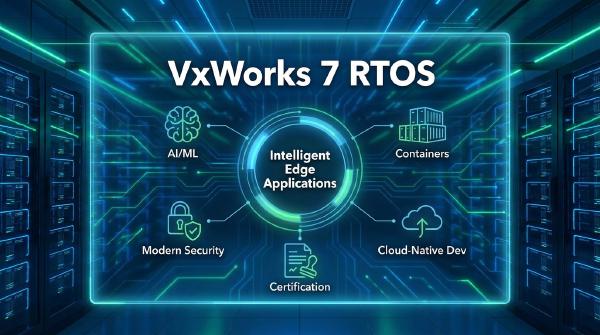
Wind River has also expanded its development ecosystem to accommodate modern application workflows, AI/ML frameworks, and container-based development practices where supported.
This flexibility allows developers to retain conventional embedded programming techniques while adopting newer tools and software components.
The important engineering boundary is between development convenience and target execution requirements. A high-level framework may simplify application development, but its runtime characteristics, memory consumption, and scheduling behavior still need to be evaluated before using it in a hard real-time execution path.
Built-In Security Mechanisms #
Connected embedded systems face threats that extend beyond ordinary software defects.
Unauthorized firmware updates, compromised communication channels, data exposure, and malicious access to system resources can all affect operational safety and reliability.
VxWorks provides security technologies that can be combined according to the target platform’s requirements.
These include:
- Secure boot and controlled software loading.
- Access-control mechanisms.
- Memory protection and kernel hardening.
- Secure communication protocols.
- Data encryption and protected storage.
- Trusted Platform Module (TPM) integration.
- Support for hardware security technologies such as Arm TrustZone on applicable platforms.
Security must be implemented throughout the system lifecycle. Protecting the boot process is useful, but it does not replace runtime access control, vulnerability management, secure update procedures, or monitoring of external interfaces.
Networking, Connectivity, and Middleware #
Embedded devices increasingly communicate with other controllers, industrial networks, cloud services, and distributed computing platforms.
VxWorks provides networking and middleware options that address these integration requirements.
Depending on the selected configuration, supported technologies include:
| Technology | Typical application |
|---|---|
| PTP | Precision clock synchronization |
| TSN | Time-sensitive Ethernet communication |
| CAN | Automotive and industrial control networks |
| OPC UA | Industrial interoperability |
| MQTT | Lightweight messaging and telemetry |
| TCP/IP | General-purpose network communication |
| OpenMP | Parallel application processing |
| File systems | Persistent storage and data management |
The availability of individual protocols and middleware components depends on the VxWorks release, hardware platform, and licensed software packages.
For systems that combine hard real-time control with industrial networking, the design must account for network scheduling, interrupt load, communication latency, and the effect of background traffic on application deadlines.
🏗️ A Modular Architecture for Different Embedded Requirements #
VxWorks is not limited to one fixed software configuration. Its architecture allows developers to select the components required by their applications.
At a high level, the platform can be viewed as several cooperating layers.
Real-Time Kernel #
The kernel provides the fundamental operating-system services, including task scheduling, interrupt management, synchronization, memory management, and inter-task communication.
This layer handles the execution requirements that define the system’s real-time behavior.
Keeping the core kernel focused also allows developers to select additional functionality without automatically including every available subsystem.
User-Space Runtime Environments #
For applications that require stronger memory protection, VxWorks provides user-mode execution environments, including Real-Time Processes (RTPs).
RTPs isolate application memory from kernel memory and help prevent one application from directly corrupting another application’s address space.
This model is particularly useful when multiple development teams work on separate software components or when application faults must be contained without compromising the operating-system kernel.
Development and Debugging Tools #
Wind River Workbench provides an integrated development environment for embedded software engineering.
Depending on the toolchain and platform configuration, developers can use debugging, system analysis, target management, simulation, and performance-monitoring facilities.
These tools help engineers investigate problems that are difficult to identify through source-code inspection alone.
For example, a system may exhibit intermittent deadline violations only when several high-priority tasks execute concurrently or when network and DMA traffic increase. Runtime analysis can help identify whether the problem originates in task scheduling, interrupt processing, resource contention, or driver behavior.
Optional Safety and Security Components #
Safety and security features can be integrated according to the requirements of the target product.
Examples include partitioning services, protected application environments, secure boot mechanisms, access controls, and specialized certification-oriented components.
This modular approach allows a small-footprint controller and a complex multi-core avionics computer to use related operating-system technology without requiring identical configurations.
For an overview of the platform’s technical capabilities and development components, see the VxWorks product and technical datasheet.
🧠 Modern Development Without Sacrificing Real-Time Behavior #
One persistent challenge in embedded development is balancing modern software practices with deterministic execution.
Traditional embedded projects often rely on tightly controlled toolchains, specialized debugging environments, and low-level programming techniques. These remain necessary for many safety-critical applications, but they can make development difficult when teams need to integrate machine learning, advanced networking, distributed services, or complex user-space software.
VxWorks addresses this problem by supporting a broader development ecosystem around its real-time foundation.
Combining Real-Time Control and Advanced Processing #
Consider an industrial robotic controller.
The motion-control subsystem must execute within predictable timing boundaries. Sensor acquisition, actuator control, and safety-related functions cannot tolerate arbitrary delays.
At the same time, the system may need image processing, predictive maintenance, machine-learning inference, and network-based coordination.
These workloads have different execution characteristics.
A practical design separates the deterministic control path from processing tasks that can tolerate more variable execution times. Memory protection, task priorities, processor allocation, and scheduling policies help control interactions between them.
Where supported, multi-core processing and virtualization can provide additional separation between real-time and general-purpose workloads.
The goal is not to make every application hard real-time. It is to ensure that non-real-time workloads cannot interfere with the deadlines of the functions that require deterministic execution.
Using AI and Machine Learning in Embedded Systems #
AI and ML are becoming common in industrial inspection, autonomous systems, predictive maintenance, and intelligent edge devices.
However, running an inference framework on an RTOS does not automatically make the inference workload deterministic.
Developers must evaluate model execution time, memory consumption, accelerator access, data-transfer overhead, and interference with other tasks.
A sensible architecture often assigns hard real-time control to bounded execution paths while treating AI/ML processing as a separate workload with explicitly managed resource requirements.
This allows systems to benefit from advanced processing without compromising the timing assumptions of their control functions.
Container-Based and Familiar Development Workflows #
Container-based development can simplify software packaging, dependency management, and reproducible build environments.
It is useful for separating development tools and application dependencies, particularly in projects involving multiple software teams.
However, container support must be understood in the context of the actual target architecture and product configuration. Containers are not a replacement for processor scheduling, memory protection, or real-time resource management.
The same principle applies to Python, POSIX APIs, and higher-level application frameworks: they improve development flexibility, but engineers still need to understand their target-side runtime behavior.
For a broader look at VxWorks 7’s architecture, security capabilities, and development model, see VxWorks 7: A Modern RTOS for Embedded and IoT Systems.
🔧 Evaluating VxWorks for a Production Embedded Project #
Selecting an RTOS should involve more than comparing feature lists or licensing costs.
For a production system, engineering teams should evaluate the platform against the complete application lifecycle.
Several questions deserve attention before committing to a design.
Hardware and BSP Maturity #
Does the selected VxWorks release support the target processor and board?
Are the required device drivers available? Are interrupt controllers, DMA engines, Ethernet interfaces, and storage devices supported by the BSP?
A mature BSP can reduce integration effort, but hardware-specific validation remains necessary.
Real-Time Performance #
Does the platform meet the application’s worst-case timing requirements under representative workloads?
Measure interrupt latency, task-switching overhead, synchronization delays, memory-access behavior, and scheduling jitter.
For multi-core systems, include shared-cache contention and memory-bandwidth interference in the analysis.
Safety and Certification Requirements #
Which certification standard applies to the product?
Does the selected VxWorks edition provide the required certification artifacts? Are the processor architecture, BSP, libraries, and application execution model covered by the available evidence?
The certification strategy should be established early rather than treated as a final testing activity.
Security and Maintenance #
What security mechanisms are available for the selected configuration?
How are vulnerabilities tracked and addressed? What update and patch-management process is supported? Can the software platform be maintained throughout the expected service life of the product?
These questions are especially relevant for connected devices deployed in industrial, transportation, aerospace, and defense environments.
Development Tools and Technical Support #
Do the development tools support the team’s workflow?
Can developers debug target-side applications, analyze runtime behavior, inspect system resources, and reproduce timing problems?
Also evaluate the availability of BSP maintenance, technical support, software updates, and service-level commitments.
These factors can have a substantial effect on development cost, integration schedules, and long-term product maintenance.
(Based on Wind River’s “Embedded World No.1 RTOS” presentation, October 2023.)