VxWorks vs. RTLinux: Real-Time Performance Analysis
📄 Abstract #
This study compares the performance and suitability of two real-time operating systems (RTOS): the commercial VxWorks and the publicly available RTLinux. Using the same hardware platform and multiple measurement techniques, we evaluate operating-system overhead across context switching, interrupt processing, synchronization, and inter-process communication (IPC). We also examine how effectively each system handles priority inversion.
The results indicate that both VxWorks and RTLinux deliver competitive raw performance. However, in the test environment evaluated, VxWorks demonstrates more consistent context-switching behavior and lower interrupt latency, making it a strong candidate for applications with strict timing requirements. RTLinux performs better in selected operations, including priority-inversion resolution and message passing.
These findings highlight an important distinction in real-time operating system evaluation: low average latency is valuable, but predictability and bounded execution time are equally important when designing systems with hard real-time deadlines.
Scope note: The experiments use VxWorks 5.4 and RTLinux 3.0 on a specific hardware platform. The results should be interpreted as historical, platform-specific measurements rather than a direct benchmark of modern VxWorks or contemporary real-time Linux implementations.
🔍 Introduction #
Real-time operating systems must execute tasks within specified timing constraints. Their suitability depends not only on computational throughput but also on scheduling responsiveness, interrupt handling, synchronization overhead, and predictable access to shared resources.
This study evaluates VxWorks and RTLinux using a consistent hardware environment and a common set of performance metrics. The objective is to understand how their kernel-level implementations affect responsiveness, timing consistency, and the ability to meet real-time deadlines.
Overview of VxWorks #
VxWorks is a commercial RTOS developed by Wind River for embedded applications requiring predictable execution and reliable real-time scheduling. Historically, its microkernel architecture has supported preemptive priority-based scheduling and round-robin scheduling, allowing developers to select policies appropriate to their workloads.
VxWorks also provides a comprehensive development toolchain and runtime library designed to simplify embedded software development, debugging, and deployment. These capabilities can reduce development effort for complex real-time applications, although commercial licensing and associated costs must be considered.
Overview of RTLinux #
RTLinux was designed to provide hard real-time execution alongside the broader Linux operating-system environment. Its original architecture used a small real-time kernel to manage time-critical operations while scheduling the conventional Linux kernel as a lower-priority execution environment.
This architecture allows real-time tasks to execute predictably while Linux provides general-purpose operating-system services. The approach combines real-time control with access to a broader software ecosystem, although interactions between real-time and non-real-time workloads can affect overall system behavior.
The RTLinux distribution discussed in this historical study was associated with Finite State Machine. Its availability and licensing model were among the factors that made it an alternative to commercial RTOS platforms.
📊 Performance Metrics #
The benchmark focuses on six areas that influence real-time operating system responsiveness and determinism.
Context Switching #
Context switching is the process of suspending one task and restoring another task’s execution state. It is fundamental to multitasking systems in which multiple asynchronous activities compete for processor time.
Context-switching latency affects how quickly the scheduler can transfer CPU ownership between tasks. Its consistency is especially important when time-critical tasks must respond to periodic events or preempt lower-priority work.
Priority Inversion #
Priority inversion occurs when a high-priority task cannot proceed because a lower-priority task holds a shared resource that the high-priority task needs. The situation can become more severe when an intermediate-priority task preempts the lower-priority task, delaying resource release.
This behavior can lead to excessive blocking and missed deadlines. Priority inheritance is a common mitigation: temporarily raising the priority of the resource-holding task helps it complete its critical section and release the resource sooner.
The benchmark evaluates how effectively each RTOS handles a controlled priority-inversion scenario.
Interrupt Latency #
Interrupt latency is the delay between an interrupt event and the execution of its interrupt service routine (ISR). Depending on the measurement definition, it can include interrupt masking or blocking, kernel response time, processor-state preservation, interrupt-source identification, and dispatch to the handler.
Nested interrupts and other kernel activities can also affect observed latency. Because many embedded systems depend on external events, timer interrupts, and peripheral notifications, low and predictable interrupt latency is essential for meeting timing constraints.
Synchronization Overhead #
Real-time applications frequently use synchronization primitives to coordinate tasks and protect shared resources. Semaphores are a common mechanism for ensuring controlled access to shared objects.
Acquiring and releasing a semaphore incurs operating-system overhead. When a task must wait for a resource, additional costs can arise from task-state transitions, queue management, and rescheduling.
This benchmark focuses on the time required to acquire a binary semaphore when it is available, isolating the uncontended acquisition path from blocking and wake-up overhead.
Inter-Process Communication #
Modern embedded applications commonly divide functionality into cooperating tasks. In addition to synchronization primitives, message queues allow tasks to exchange data and coordinate their activities.
Message-queue operations require additional work, such as managing queued messages, waking blocked receivers, and scheduling the receiving task. Consequently, IPC latency is an important measure of how efficiently an RTOS supports communication between concurrent tasks.
Measurement Methodology #
Accurate performance analysis requires measurement tools with sufficient resolution and minimal influence on the behavior being measured.
This study primarily uses a hardware logic analyzer because it provides fine-grained timing measurements with limited instrumentation overhead and can be applied independently of the operating system. A software analyzer is used for verification in selected tests.
Additional firmware was developed to configure memory mappings and interrupt vector tables, adjust the system timer, and disable the hardware cache. Test functions and system calls used to initialize tasks, semaphores, and message queues were designed to be POSIX-compliant.
Each test used 25 measurement samples. The collected data were summarized using average latency and standard deviation where applicable. Although this sample size provides an initial view of timing behavior, it is not sufficient by itself to characterize worst-case execution time or establish formal real-time guarantees.
Test Environment #
The experiments used the following software versions:
| Component | Version or configuration |
|---|---|
| VxWorks | 5.4 |
| RTLinux | 3.0 |
| Hardware | Evaluation boards with associated board support packages |
| Measurement tools | Hardware and software logic analyzers |
| Sample size | 25 measurements per test |
Using evaluation boards and their associated board support packages reduced the time spent configuring the hardware and helped maintain a consistent test environment.
Because kernel versions, processor architecture, compiler configuration, interrupt topology, and hardware timing characteristics influence performance, the findings apply primarily to the configurations used in this study.
📚 Related Work #
Previous research has explored operating-system scheduling, synchronization, interrupt handling, and measurement techniques in real-time environments.
Levine and colleagues investigated context-switching time and priority-inversion protocol latency in a real-time CORBA architecture. Although their work provides useful benchmarking context, the priority-inversion detection method was comparatively complex. Obenland’s work describes a more direct approach to constructing and measuring priority inversion, which informed the methodology used here.
Sohal studied interrupt latency analytically and experimentally, separating the different phases of interrupt processing. Given the project’s time constraints, this study adopted a single interrupt-latency test intended to expose the principal timing characteristics of interrupt handling.
The study did not adopt Sun’s proposed approach, because the interrupt mechanisms under consideration differ between conventional Linux and the RTLinux architecture examined here.
Obenland’s work also highlights an important requirement for IPC benchmarks: the message queue should initially be empty, and the receiving task should be blocked waiting for a message before the sender transmits it. This setup makes the measurement more representative of the send-and-wake-up path.
Steward’s work discusses measurement techniques with different levels of resolution and instrumentation overhead. Consistent with that analysis, this study prioritizes hardware logic-analyzer measurements over software-only timing instrumentation.
The original paper’s numbered references are retained where provided; a complete reference list is needed to resolve the source numbering consistently.
🧪 Test Methods and Experimental Results #
The experimental methods were adapted from previous research to provide consistent measurements across both operating systems. Each test isolates a specific kernel operation wherever possible, allowing the measured overheads to be compared under controlled conditions.
Context Switching #
Both RTOS configurations used round-robin scheduling to measure context-switching latency. Under this policy, tasks with the same priority share processor time, allowing a straightforward test with two tasks that execute alternately.
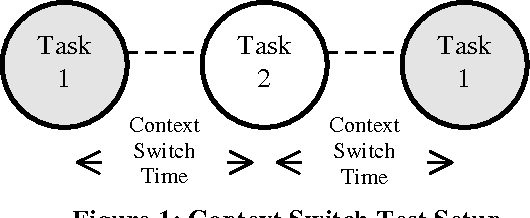
Both test tasks execute an infinite empty loop to minimize additional computation and isolate scheduling overhead.
The average context-switching time and standard deviation were measured in microseconds, as summarized in Table 1.
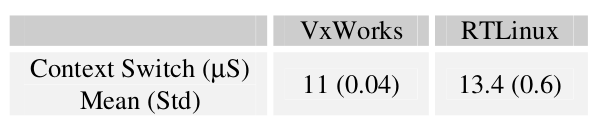
The measurements show that VxWorks maintains consistently low context-switching latency, with a reported standard deviation of 0.04. RTLinux exhibits approximately 18% higher context-switching time and greater variation, with a reported standard deviation of 0.6.
These results suggest that VxWorks delivered more consistent task-switching behavior in the tested configuration. The higher RTLinux overhead may reflect the additional architectural complexity of supporting real-time and general-purpose Linux execution together. However, the measurements alone do not establish that this architectural model is unsuitable for embedded applications; that conclusion depends on workload requirements and the behavior of the specific implementation.
Priority Inversion #
The priority-inversion test uses three tasks with different priorities:
- High priority:
tCyclicTask - Medium priority:
tWorkTask - Low priority:
tSlowTask
The high- and low-priority tasks compete for the same shared resource. When the low-priority task holds the resource, the high-priority task blocks while requesting it. If the medium-priority task preempts the low-priority task, the resource remains unavailable for longer, creating a priority-inversion scenario.
The resulting behavior was captured with a software analyzer.
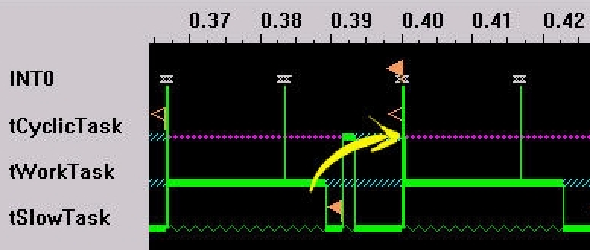
Several measurements were taken from the moment tCyclicTask requested the resource until tSlowTask released it. The results are summarized in Table 2.
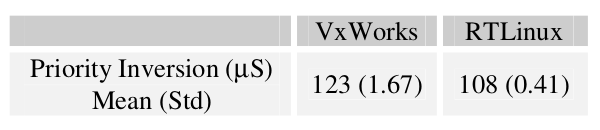
RTLinux resolved the tested priority-inversion scenario more quickly than VxWorks. Both systems, however, produced results that the study considered acceptable for its test conditions.
This suggests that both implementations provided effective mechanisms for mitigating the tested priority-inversion behavior. The result should not be interpreted as a general guarantee that either operating system will meet all deadlines: real-time assurance also depends on worst-case blocking time, interrupt behavior, scheduler configuration, and resource-access patterns.
Interrupt Latency #
The interrupt-latency experiment used an MPC8260 hardware timer configured from a 50 MHz timing source to generate a timer interrupt every 20 microseconds. An ISR was registered in the interrupt vector table to update a system tick counter.
A hardware logic analyzer measured the time between the assertion of the timer interrupt and execution of the ISR.
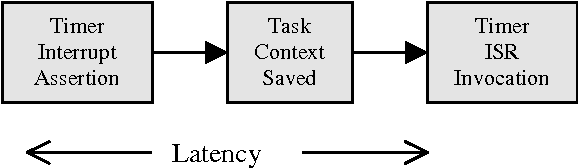
To reduce measurement interference, other system interrupts were disabled so that nested interrupt handling would not affect the results.
Average interrupt latency and standard deviation were recorded for both systems, as shown in Table 3.
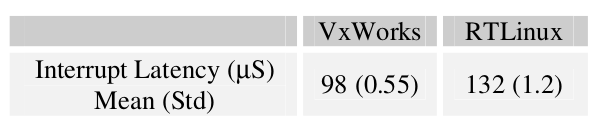
VxWorks exhibited approximately 35% lower interrupt latency than RTLinux in this experiment.
The result is consistent with the study’s broader observation that VxWorks offered strong timing responsiveness in the selected test environment. It should not be generalized to every Linux-based real-time system, however. Interrupt handling and latency depend heavily on the kernel architecture, configuration, hardware platform, and measurement methodology.
Synchronization #
The synchronization benchmark measures the overhead of acquiring a binary semaphore in each operating system.
First, a binary semaphore was created and initialized as unavailable. Two tasks were then arranged so that one released the semaphore before the other attempted to acquire it. This ordering ensures that the acquiring task does not block while waiting for the resource.
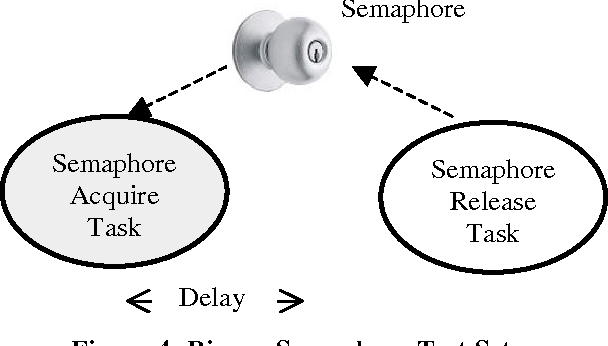
The measurement captures the time taken by the task to execute the semaphore-acquisition system call. Average acquisition overheads for VxWorks and RTLinux are reported in Table 4.
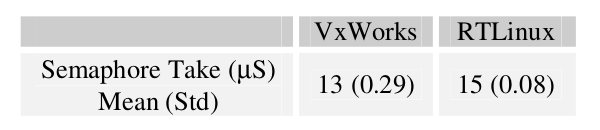
RTLinux took slightly longer to acquire a binary semaphore than VxWorks in the tested scenario.
Because the semaphore was available before the acquisition request, this test primarily measures the uncontended path. It does not characterize the potentially larger overhead associated with blocked tasks, priority inheritance, task wake-up, or rescheduling.
Inter-Process Communication #
The IPC test measures the delay involved in sending a message from one task to another through a message queue.
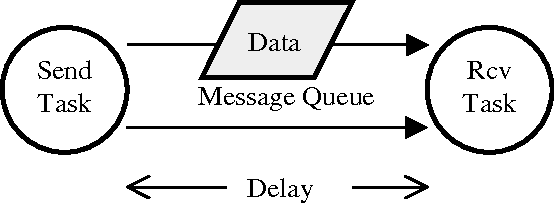
The procedure consists of the following steps:
- Create and activate the message queue.
- Start a receiving task that invokes the message-receive operation.
- Allow the receiving task to block while the message queue is empty.
- Start a sending task that transmits a message through the same queue.
- Measure the interval between the sender’s message-send operation and the receiving task’s notification or wake-up.
The measurements are summarized in Table 5.
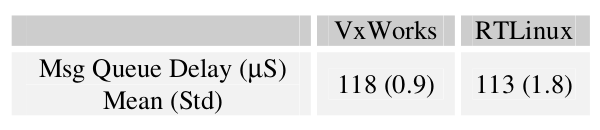
RTLinux achieved slightly lower message send/receive latency than VxWorks in this experiment.
The outcome illustrates that performance differences vary by operation. An operating system that performs better in interrupt handling or context switching may not necessarily achieve the lowest IPC latency.
Results also depend on the communication mechanism. Message queues introduce their own management overhead, whereas shared-memory communication can reduce copying and queue-management costs when the application can safely manage synchronization and data ownership itself.
📝 Conclusions and Future Work #
This study evaluates VxWorks and RTLinux across context switching, priority inversion, interrupt latency, semaphore acquisition, and message-queue communication.
The results show that both operating systems can provide competitive performance for real-time applications, but their relative strengths differ by workload:
| Metric | Result observed in this study |
|---|---|
| Context switching | VxWorks showed lower latency and less variation |
| Priority inversion | RTLinux resolved the tested scenario faster |
| Interrupt latency | VxWorks showed approximately 35% lower latency |
| Binary semaphore acquisition | RTLinux had slightly higher overhead |
| Message-queue IPC | RTLinux achieved slightly lower latency |
Overall, VxWorks demonstrated more consistent context-switching behavior and lower interrupt latency in the tested environment. These properties make predictability an important consideration when evaluating it for time-critical embedded applications. RTLinux performed better in selected synchronization-related scenarios, illustrating that raw performance depends on the operation being measured.
However, the benchmark covers only a limited subset of operating-system functionality and focuses on kernel-level behavior. It does not provide a comprehensive comparison of networking, file systems, runtime libraries, device drivers, application-level throughput, or total development and deployment costs.
Further work should include larger sample sets, explicit worst-case latency measurements, tests under realistic processor and interrupt loads, and a broader range of IPC and synchronization patterns. Modern implementations should also be evaluated independently rather than assuming that results from VxWorks 5.4 and RTLinux 3.0 apply to current operating systems.
Ultimately, choosing an RTOS requires more than comparing average latency. Engineers must consider timing determinism, worst-case execution behavior, hardware compatibility, software ecosystem, licensing, development cost, and the consequences of missing a deadline. A comprehensive, workload-specific evaluation is therefore necessary to determine which platform best fits a given embedded system.